
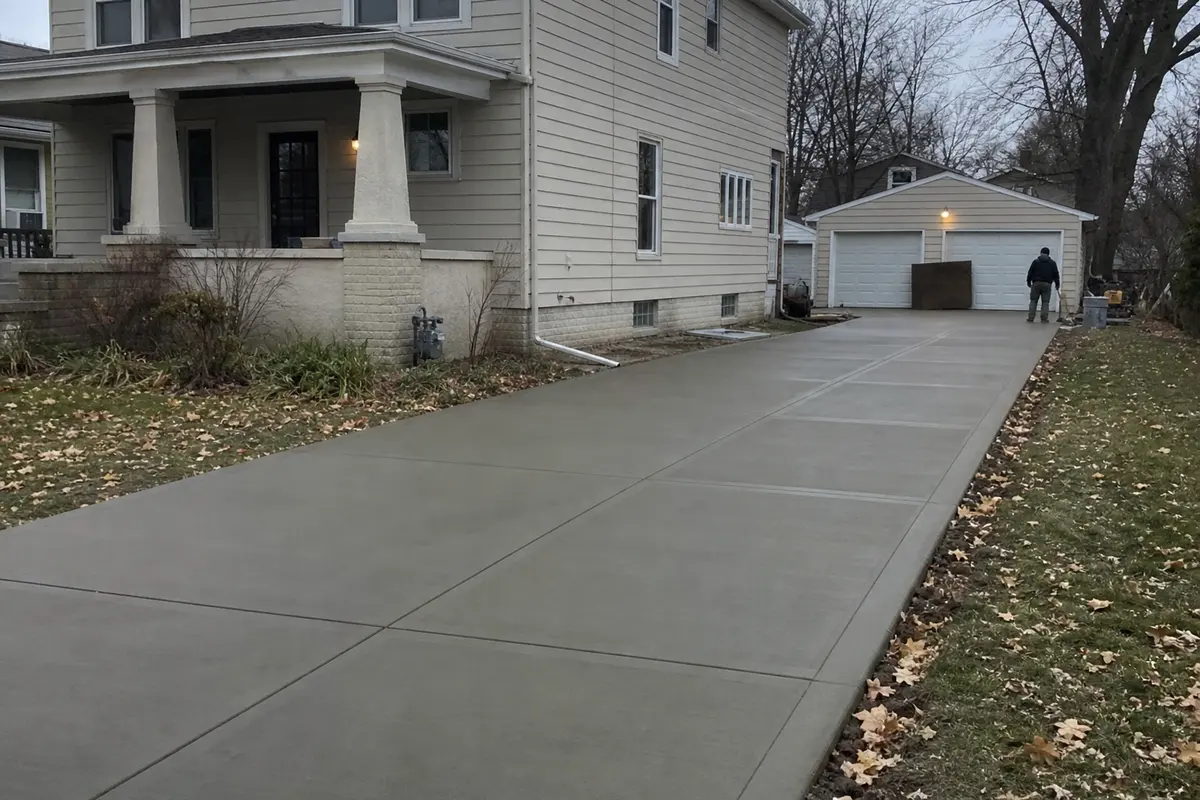
Concrete vs Asphalt Driveway in Northern Illinois
Updated
Get a free quote
A concrete contractor replies with a price. Nothing is booked until you say yes.
Rather talk? Call (815) 420-3970 or text us.
Short answer
Part of Concrete Driveways.
If you are planning a new drive, you are picking between a concrete driveway and asphalt. Rockford's zoning code bars gravel (see the gravel driveway guide), so most homeowners end up comparing these two. This guide sticks to what local codes and national sources say, and it says plainly where there is no good number.
What local codes allow
Each town sets its own spec, but none of these pick a winner. They accept either material and set a minimum build.
| Town | Concrete option | Asphalt option |
|---|---|---|
| Rockford (apron) | 6 in non-reinforced concrete | 8 in aggregate base with 2 in bituminous surface (Appendix O) |
| Machesney Park | At least 4 in thick | 2 in bituminous on 8 in aggregate base (Sec. 30-90) |
| Roscoe | At least 4 in thick | 2 in bituminous on 6 in aggregate base (Sec. 15-410) |
| Durand | 3 ft concrete apron where the street is concrete (bituminous drive) | At least 2 in surface on 6 in macadam base (Village of Durand Code) |
Durand also says a residential driveway must be at least equal to the adjacent street paving, so the street decides some of the choice there. How thick each town wants concrete is in our guide on how thick a concrete driveway should be.
Price: what the sources give
National 2026 cost guides put a poured concrete driveway at $8 to $20 per sq ft, and a two car driveway of 24 by 24 feet at $4,600 to $8,600(Angi). HomeGuide gives a wider range for replacing a driveway in any material, $4 to $15 per sq ft (HomeGuide). Those are typical national ranges, not a quote for a Rockford job. The concrete cost page has the full set.
No sourced per square foot price for an asphalt driveway turned up, so none is printed here. The closest figure is for commercial parking lots, where Angi puts asphalt at $2 to $4 a square foot and concrete at $4 to $7 (Angi, parking lot cost). A lot is a bigger, simpler job than a driveway, so use that only as a sign that asphalt costs less up front. Get both priced for your own driveway before you decide.
Where the street and the apron decide for you
Some of the choice is made at the property line. Rockford's apron rule allows either material, so you are free to match the rest of the drive or not. Rockton's code is more specific. A driveway apron or any part in the right-of-way needs 6 inch Portland cement concrete on 2 inches of compacted CA-6, or 3 inch bituminous on 10 inches of CA-6 (Sec. 151.069). Whatever you pick for the rest of the drive, the part by the street has to meet that spec, and the sidewalk crossing is its own concrete detail. If your new drive will be next to a sidewalk, see concrete sidewalks.
How each one handles an Illinois winter
Rockford averages 135.8 days a year with a low of 32 degrees or colder, and 37.1 inches of snow (National Weather Service normals). That is a lot of freeze-thaw cycles for any surface.
Concrete handles it when the mix is right. The 2024 IRC calls for exposed concrete in severe weathering regions to reach 3,500 psi at 28 days and carry 5 to 7 percent air entrainment (IRC R402.2). Machesney Park writes the same strength and air requirement into its driveway code. Air bubbles give freezing water room to expand, which cuts scaling.
Deicers are the weak point. The Federal Highway Administration says chemical deicers are the most severe freeze-thaw exposure for concrete (FHWA), and the Portland Cement Association says deicers with ammonium nitrate or ammonium sulfate severely attack concrete and should not be used (PCA). New concrete also needs time before salt, as covered in the guide on concrete curing time. Asphalt does not face that exact problem, so salt matters less on it.
Upkeep and how they age
None of this part comes from a code. It is general trade knowledge, and the sources we cite do not give a lifespan for either material, so none is claimed here.
- Asphalt is flexible. It tolerates small movement in the ground, but it needs periodic resealing, and it can soften in summer heat and show tire marks.
- Concrete is rigid. It does not need sealing to hold together, but it does crack. Joints are cut or tooled so the slab cracks where you want it to. The PCA rule of thumb is joint spacing of 24 to 30 times the slab thickness.
- Repairs differ. A cracked slab is a section repair or a new pour. Patching asphalt is usually a matching-patch job, which often shows. See concrete repair for how cracks are handled.
- Looks and finish. Concrete takes a broom finish, and a stamped pattern is an option. Asphalt is one dark color.
Questions to ask both installers
Whichever material you price, put the same questions to every bidder so the bids compare.
- What is the thickness and what is under it, in inches, for the drive and for the apron?
- For concrete: what strength and air content is the mix, and where are the joints?
- For asphalt: how many layers, and when does the installer say it should be sealed?
- Who pulls the permit, and is the contractor's insurance and bond on file with the city for the apron?
- How is water drained off the finished surface and away from the house?
How to decide
Pick concrete if you can pay more now, want a light surface with a clean edge and are careful with deicers. Pick asphalt if your budget is tight or the street in front of you is asphalt and the village code says to match it. Whichever you pick, a permit is still needed in Rockford, as described in the guide to the Rockford driveway permit.
Sources: City of Rockford, Appendix O engineering design criteria; Rockton Code of Ordinances, Sec. 151.069 (driveways); Machesney Park Code of Ordinances, Ch. 30 (driveways); Village of Roscoe, driveway ordinance Sec. 15-410; Village of Durand Code, Chapter 15 (streets and sidewalks); Angi, concrete driveway cost; HomeGuide, driveway cost; Angi, cost to pave a parking lot; National Weather Service, Rockford 1991-2020 normals; 2024 International Residential Code, R402.2 (concrete); FHWA, durability of concrete pavements (HIF-17-008); Portland Cement Association, Design and Control of Concrete Mixtures (EB001)
Want a price for your own house?
Call, text, or send the form. You get a price back before any work is scheduled.
Quick answers
Is concrete or asphalt better for a driveway in Illinois?
Local codes in Rockford, Machesney Park and Roscoe allow either, so it comes down to price and winter use. Concrete costs more up front at $8 to $20 per sq ft nationally and needs care with deicers; asphalt needs periodic resealing. See the cost page.
How much does a concrete driveway cost compared to asphalt?
National 2026 guides put concrete at $8 to $20 per sq ft. No sourced asphalt driveway price turned up, but Angi's parking lot figures show asphalt at $2 to $4 a square foot against $4 to $7 for concrete. See the cost page.
Does concrete crack in Rockford winters?
Rockford has 135.8 days a year at or below 32 degrees. Air-entrained concrete at 3,500 psi with control joints is built for that, and cracks tend to follow the joints.
Can I use salt on a concrete driveway?
Deicers are the harshest exposure for concrete according to the FHWA. The PCA says avoid deicers with ammonium nitrate or ammonium sulfate, and new concrete needs time to cure and dry first.
What does Rockford require for a driveway apron?
The apron from the roadway to the property line is 6 inch non-reinforced concrete, or an 8 inch aggregate base with a 2 inch bituminous surface. Both are allowed.
Does asphalt need to be sealed?
Asphalt driveways generally need periodic resealing, which is general trade knowledge. The sources we use give no interval, so ask the paver what schedule they recommend.
Want a price on the job?
Send the job, the town and a rough size. A concrete contractor replies with a price before any work starts.
Prices and the full service list are on the homepage for a concrete contractor in Rockford.