
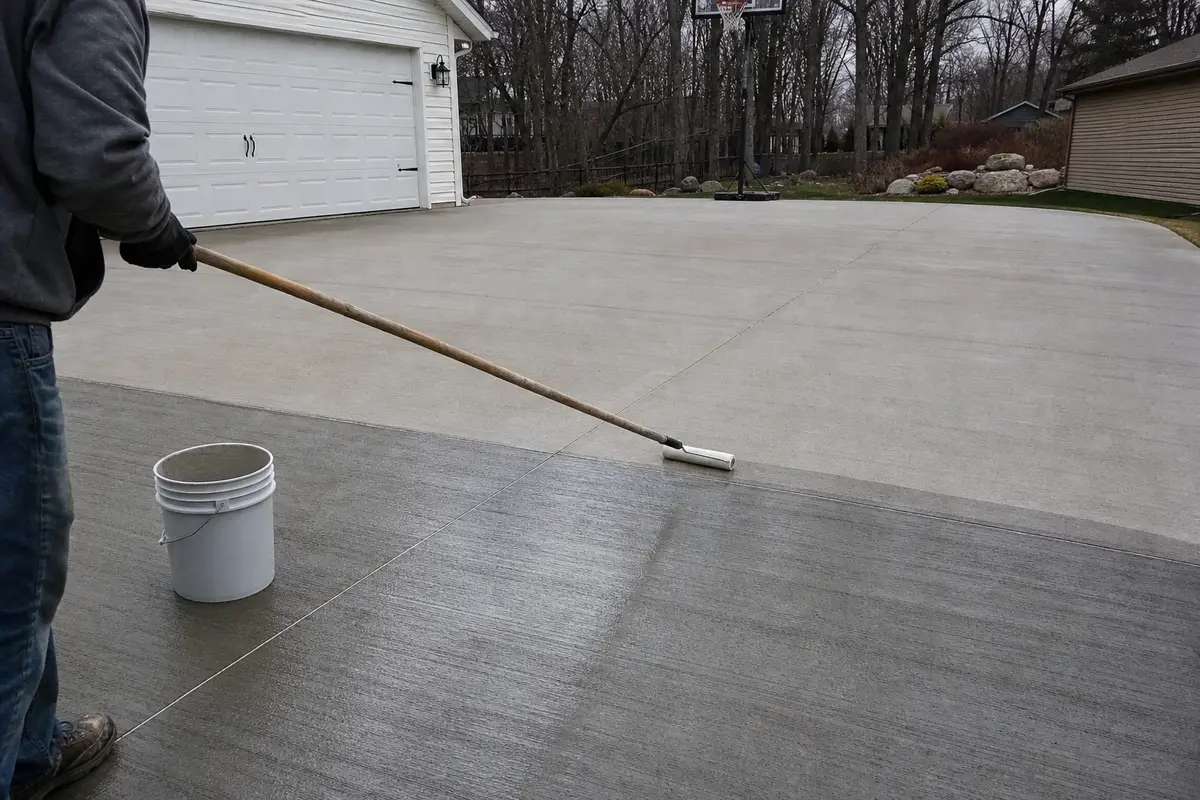
Concrete Sealing for Driveways, Patios and Stamped Concrete in Rockford, IL
Updated
Get a free quote
A concrete contractor replies with a price. Nothing is booked until you say yes.
Rather talk? Call (815) 420-3970 or text us.
Short answer
Ready for a price on concrete sealing?
Call, text, or send the form. You get a price back before any work is scheduled.
A sealer is a coating or a penetrating liquid that slows water and salt entering the surface. In Rockford, with 135.8 freezing days a year, that matters on a driveway, a patio, a walk or stamped concrete that stays wet from snow. This page covers what sealing costs, when new concrete is ready for it, and what salt does to a slab whether it is sealed or not.
What concrete sealing costs
These are typical U.S. ranges from national 2026 cost guides, not quotes. Angi puts materials alone at $0.10 to $0.75 a sq ft, and with labor at $1.35 to $2.50 per sq ft (Angi). The concrete cost page has the other jobs.
| Item | Typical cost | Source |
|---|---|---|
| Sealing, with labor | $1.35 to $2.50 per sq ft | Angi |
| Sealer materials alone | $0.10 to $0.75 per sq ft | Angi |
| Stripping old sealer first | $1 to $3 | Angi |
Stripping adds to the bill when an old film-forming sealer has peeled or yellowed and the new coat will not bond to it. Ask whether a quote includes cleaning the slab, any stripping and how many coats go on. The same quote should say what product it is, since the product decides how long the job lasts.
When new concrete can be sealed
Do not seal new concrete early. The Portland Cement Association recommends at least 7 days of moist curing at 50°F or above, then at least a 30 day drying period before freeze-thaw and deicer exposure when the concrete is saturated (PCA). Sealing before the slab has dried can trap moisture, and a sealer label will say when its product can go on. Follow the label. The curing time guide explains the walk-on and drive-on timeline.
A slab poured in late fall may not get its 30 days of drying before the first freeze. If the calendar does not fit, the safest plan is no salt on it that winter.
Which deicers damage concrete
The PCA says deicers with ammonium nitrate or ammonium sulfate severely attack concrete and should not be used, and that all deicers can aggravate scaling on concrete that is not properly air entrained (PCA). The FHWA links the growing use of calcium chloride and magnesium chloride solutions to shadowing at joints, which can progress to disintegration of the concrete (FHWA). Check the bag before spreading anything on a driveway or walk.
The Illinois Ready Mixed Concrete Association's flatwork guide goes further and says not to use salt or deicers for at least the first winter, and to use sand for traction instead (IRMCA). That is advice from the industry association, not a code rule, but it is a cheap habit that protects a new slab. The salt on concrete guide goes through the options.
Air entrainment and why a sealer is a second layer
A sealer is not what keeps concrete alive through winters. Air entrainment is. ACI explains that tiny air bubbles give freezing water room to expand and cut scaling from deicing chemicals (ACI). The 2024 IRC calls for air-entrained concrete for exposed flatwork such as porches, steps and garage floors, with 5 to 7 percent total air and 3,500 psi at 28 days in severe weathering (IRC R402.2). A sealer helps a slab that has the air. It does not rescue one that does not.
Sealing driveways, patios and stamped concrete
Plain broom-finish driveways and walks usually take a penetrating or a film-forming sealer, and a film-forming one can make a wet surface slick, so ask about a slip-resistant additive on steps and pool-side patios. Stamped concrete is the surface most worth sealing, since the color and the pattern sit in the top layer and a sealer also brings out the color; see stamped concrete. Reapplication depends on the product and the traffic, so get the maker's data sheet instead of a guess.
The main places a sealer goes in Rockford are concrete driveways, concrete patios, concrete sidewalks and garage floors. A slab with cracks or scaling should be fixed first; see concrete repair.
Penetrating sealers and film-forming sealers
There are two broad kinds. A penetrating sealer soaks into the surface and leaves no visible film, so the concrete looks nearly the same and the surface keeps its grip. A film-forming sealer sits on top as a coating, adds sheen or color depth and can look wet, but it can wear off in traffic lanes and get slick when wet. Neither one fills a cracked or scaled surface, and neither replaces joint sealant.
Which one fits depends on the slab. A broom-finish driveway that sees plows and salt is a good fit for a penetrating product. A decorative patio or a stamped concrete surface that should look rich is often finished with a film-forming one. The maker's data sheet says what the product is rated for, so ask the crew to leave the label or the sheet with you.
Sealing a garage floor
The 2024 IRC treats garage floor slabs as exposed to the weather and calls for air-entrained concrete, with 5 to 7 percent total air in severe weathering (IRC R402.2). Salt-laden slush drips off cars onto that slab all winter, so a sealer on the floor protects the surface where the bumper-to-bumper contact is greatest. Garage floors are also the place for a sealer with grip, since melt water collects there. More on the pour itself is on the garage floors page.
Care between coats
A sealed slab still needs care. Rinse salt residue off in spring, shovel instead of chipping ice with a metal blade, and use sand for traction where you can. Watch the joints, because water entering a joint is how most driveway edges start to break up. When the surface starts to look dry and thirsty, or water stops beading on it, the slab is due for a look at the sealer.
When in the year sealing works
Sealer labels set a minimum temperature and ask for dry concrete, so sealing is a warm-season job. The normal last spring freeze in Rockford is April 27 and the normal first fall freeze is October 13 (NWS, NWS), so the stretch between those dates is the working window. Follow the product label for the exact limits.
How a sealing job goes
The crew cleans the slab, usually with a pressure washer, and lets it dry fully. Oil stains and old coatings come off first, and cracks get filled. The sealer goes on in thin, even coats, because a thick coat can turn cloudy or peel. Traffic stays off for the time the label gives. A rushed job on a damp slab is the common reason a sealer turns white.
Questions to ask before a sealing bid
- Which product, and is it penetrating or a film-forming coat?
- Is cleaning, stripping and crack filling in the price?
- How many coats, and how long until cars can drive on it?
- Is a slip-resistant additive used on steps and walks?
- What does the maker say about reapplying, and when?
Parking lots and drive aisles that see plow trucks and salt every week are covered on the commercial concrete page.
Sources: Angi, concrete sealing cost; Portland Cement Association, Design and Control of Concrete Mixtures (EB001); FHWA, durability of concrete pavements (HIF-17-008); American Concrete Institute, FAQ on air entrainment; Illinois Ready Mixed Concrete Association, residential exterior flatwork guide; 2024 International Residential Code, R402.2 (concrete); National Weather Service, last freeze dates; National Weather Service, first freeze dates
Where this is done
Concrete Sealing across Rockford and the cities and villages around it. Each town page has its own driveway permit, paving and contractor rules; the full list is on the service area page.
Concrete Sealing: questions
How much does it cost to seal a concrete driveway?
National 2026 cost guides put sealing with labor at $1.35 to $2.50 per sq ft. Materials alone run $0.10 to $0.75 per sq ft. See the cost page.
How long should new concrete cure before it is sealed or salted?
The Portland Cement Association recommends 7 days of moist curing at 50°F or above, then a 30 day drying period before freeze-thaw and deicer exposure. A sealer label gives its own wait time.
Can I use salt on a new driveway the first winter?
The Illinois Ready Mixed Concrete Association says to avoid salt and deicers for at least the first winter and use sand instead. That is industry advice rather than a code rule.
Which deicers are the worst for concrete?
The PCA says deicers with ammonium nitrate or ammonium sulfate severely attack concrete. The FHWA also links calcium and magnesium chloride to joint deterioration.
Does sealing replace air-entrained concrete?
A sealer helps, but air entrainment is what gives freezing water room to expand. A slab without enough air can still scale under a sealer.
Should stamped concrete be sealed?
Sealing is the usual finish for stamped concrete, since it protects the color and the pattern. The product and the reapplication schedule come from the maker's data sheet.
Does old sealer have to come off first?
A peeling or yellowed film-forming sealer usually has to be stripped so the new coat can bond. Angi lists stripping at $1 to $3 on top of the sealing price.
Other services
Concrete Sealing: get a written price
Send the job, the town and a rough size. A concrete contractor replies with a price, and no work starts until you agree to it.
Prices and the full service list are on the homepage for a concrete contractor in Rockford.