
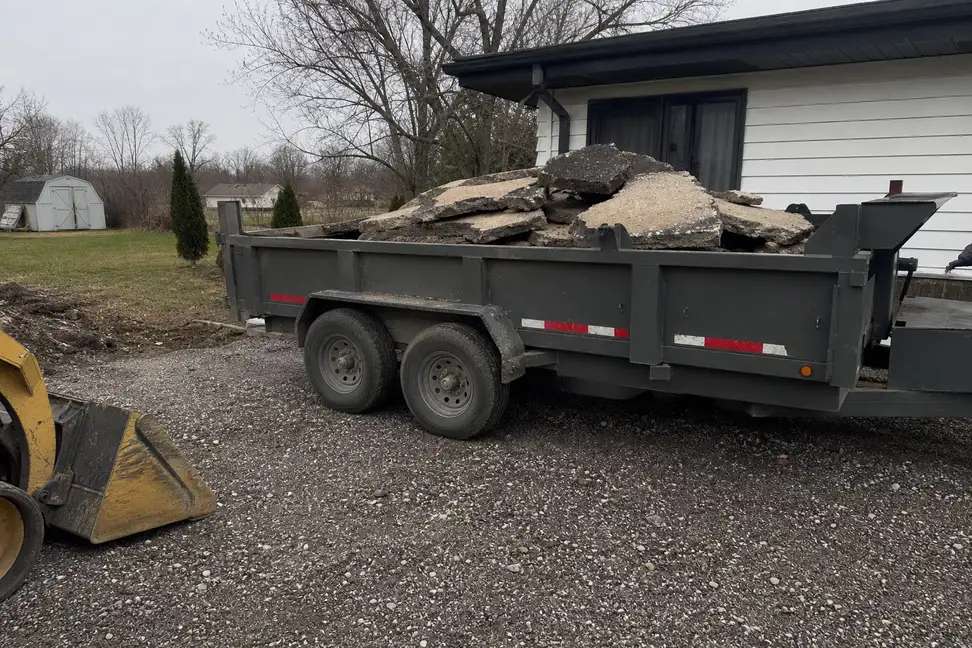
Broken Concrete Disposal in Illinois: CCDD Rules
Updated
Get a free quote
A concrete contractor replies with a price. Nothing is booked until you say yes.
Rather talk? Call (815) 420-3970 or text us.
Short answer
Part of Concrete Removal.
When a crew breaks out an old slab, the pile has to go somewhere, and in Illinois the rules treat broken concrete differently from ordinary trash. This guide is the short version of what the state says about it. It sits under concrete removal, which covers the tear-out itself. For prices tied to a driveway or patio, the concrete cost page shows the national ranges.
What counts as clean broken concrete in Illinois
Illinois EPA calls it clean construction or demolition debris, or CCDD: uncontaminated broken concrete without protruding metal bars, bricks, rock, stone or reclaimed asphalt pavement, generated from construction or demolition (Illinois EPA, CCDD). The point of the definition is that clean material is not waste. Concrete mixed with trash, paint, soil or other debris no longer fits.
Concrete with rebar
Reinforced concrete is covered by the statute itself. Under 415 ILCS 5/3.160, uncontaminated concrete with protruding rebar is considered clean construction or demolition debris, and not waste, if it is separated or processed and returned to the economic mainstream as raw material or products within four years of its generation (415 ILCS 5/3.160). In practice that means the metal gets pulled out or the pile goes to a recycler that crushes it. A driveway with wire mesh or rebar in it is a more careful tear-out than a plain slab, which is why removal costs more.
Where broken concrete can go
Clean broken concrete can be used as fill below grade without being treated as waste, as long as two conditions are met: the filled area is not within the setback zone of a drinking water well, and within 30 days after filling the concrete is covered with uncontaminated soil, pavement or some type of structure (Illinois EPA, CCDD). The Illinois EPA page does not give a distance for the setback, so ask before you plan to bury anything. In practice most homeowners do not handle this part. The crew takes the pile to a facility that accepts it or to a crushing yard. Ask where it goes, and ask whether the price includes haul-off.
| Material | Illinois treatment | What to ask your crew |
|---|---|---|
| Plain broken concrete | Clean CCDD if uncontaminated | Where it is taken and whether haul-off is in the price |
| Concrete with rebar sticking out | Clean debris if separated or processed within 4 years | Who removes the metal and where it is crushed |
| Concrete mixed with soil, trash or paint | May not qualify as clean | How the crew keeps the pile separate |
What removal and disposal cost
A national guide puts concrete removal and haul-off at $2 to $6 per sq ft, with unreinforced concrete at $2 to $4 and reinforced concrete at $4 to $7 per sq ft. Disposal alone is $51 to $100 a ton (LawnStarter). Another guide covers demolition pricing (Angi), and a driveway replacement guide puts old driveway removal alone at $1 to $3 per sq ft (HomeGuide). A 24 by 24 ft driveway is 576 sq ft, so even at the low end of the removal range the tear-out is about $1,152 at $2 per sq ft, before the new pour. These are national ranges and not local quotes.
The new slab is a separate price. If the old concrete is coming out for a new concrete driveway or a new concrete patio, ask for removal and pour in one written scope, so you do not pay for the same prep twice.
Rockford washout rules for the new pour
The new concrete makes waste too. The City of Rockford's concrete waste sheet says concrete waste is a non-stormwater discharge and may not go on the ground or into storm drains, ditches or streets. Only chutes and tools are washed on site, truck washout and leftover concrete go back to the plant, and washout areas stay at least 50 feet from storm drains, ditches and water. The washout is inspected daily, emptied or replaced when it is three quarters full, and never allowed to overflow. Hardened waste is clean debris of the same kind covered above (City of Rockford, concrete waste requirements). The city describes washout as highly alkaline, caustic and corrosive, which is why it is kept out of storm sewers.
Check before the crew starts
- Ask whether the quote includes haul-off, disposal fees and a reinforced slab if yours has mesh.
- Ask where the broken concrete goes and whether it is crushed for reuse.
- Ask where washout goes on a tight lot, and keep it away from the street.
- Put all of it in the written contract. Illinois requires one for home repair work over $1,000.
Planning the tear-out
Before anything is broken out, state law requires a call to JULIE 3 to 10 days before any digging (JULIE). In Rockford, stabilization of bare ground starts within seven days after work stops (City of Rockford, 2026 application), so a tear-out that sits open for weeks is not a good plan. Ask the crew when the new pour is scheduled and what the lot looks like in between. Old slab on a tight lot also needs a place for the truck or dumpster to sit.
Reusing old concrete on your own lot
Some crews crush old concrete and use it as base under the new slab, which cuts hauling. Whether that works depends on the size of the pieces, the compaction and the rules above for fill, so it is a question for the crew, not a do-it-yourself call. If the plan is to bury broken concrete on your own property, read the 30 day cover rule and the well setback first, and ask the Illinois EPA or the local building office if you are unsure.
Sources: Illinois EPA, clean construction or demolition debris; 415 ILCS 5/3.160 (construction debris definition); LawnStarter, concrete removal price; Angi, concrete demolition cost; HomeGuide, driveway cost; City of Rockford, concrete waste requirements; Illinois Home Repair and Remodeling Act, 815 ILCS 513/15; JULIE (Illinois One-Call), when to call; City of Rockford, 2026 driveway, curb cut, sidewalk and approach permit application
Want a price for your own house?
Call, text, or send the form. You get a price back before any work is scheduled.
Quick answers
Can I dump broken concrete in Illinois?
Illinois EPA treats clean broken concrete as clean construction or demolition debris, and it can be used as fill below grade if it is outside a well setback and covered within 30 days. Ask a recycler or landfill what it accepts.
What is CCDD?
CCDD means clean construction or demolition debris. Illinois EPA defines it as uncontaminated broken concrete without protruding metal bars, bricks, rock, stone or reclaimed asphalt pavement.
Is concrete with rebar considered clean debris in Illinois?
State law treats uncontaminated concrete with protruding rebar as clean debris if it is separated or processed and returned to use within 4 years.
How much does concrete removal cost?
National cost guides put concrete removal and haul-off at $2 to $6 per sq ft, with disposal of $51 to $100 a ton. See the cost page.
Where does concrete washout go in Rockford?
The city says to wash only chutes and tools on site, send truck washout back to the plant and keep washout at least 50 feet from storm drains, ditches and water.
Can broken concrete be reused as fill?
Illinois EPA lets clean broken concrete be used as fill below grade if the area is outside a drinking water well setback and the concrete is covered within 30 days.
Want a price on the job?
Send the job, the town and a rough size. A concrete contractor replies with a price before any work starts.
Prices and the full service list are on the homepage for a concrete contractor in Rockford.