
Concrete Crack Repair: Which Cracks Matter
Updated
Get a free quote
A concrete contractor replies with a price. Nothing is booked until you say yes.
Rather talk? Call (815) 420-3970 or text us.
Short answer
Part of Concrete Repair.
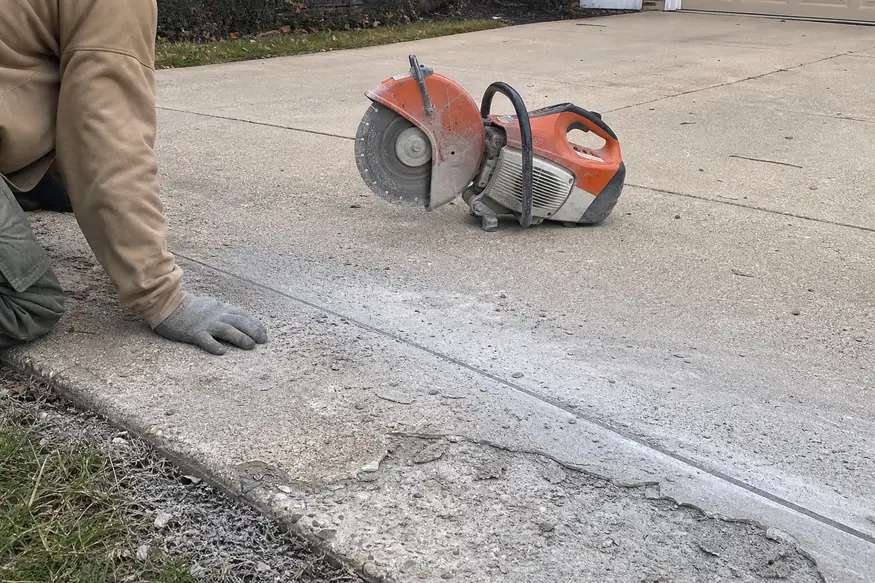
Concrete cracks. That is not a flaw so much as a property of the material, and a good concrete repair starts with working out which kind of crack you have. Some cracks are narrow lines that never change. Others widen, separate or sink, and those are a sign that the problem is under the slab. This guide covers why cracks form, how to read them, and how crews fix them.
Why concrete cracks
Wet concrete shrinks as it dries, and a big flat slab has no way to shrink freely, so it cracks unless the crew gives it a place to do so. There are four common causes:
- Shrinkage. The slab loses water and gets slightly smaller. This is why new slabs crack in the first weeks.
- Freeze-thaw. Water gets into the surface, freezes and expands. Rockford has 135.8 days a year at 32°F or colder (NWS normals), so this one does a lot of work.
- Settlement. Soil under the slab washes out or compacts and the concrete loses its support. A thin or wet base makes this worse.
- Overloading. A heavy truck or a thin slab. A driveway that was never meant to carry a delivery truck can crack under one.
How joints control cracking
A contraction joint is a groove cut or tooled into the slab so the concrete cracks at the groove instead of anywhere it likes. The PCA says joints in slabs on ground should be spaced at 24 to 30 times the slab thickness (PCA EB001). The Illinois Ready Mixed Concrete Association's residential flatwork guide asks for control joints at least one quarter of the slab thickness deep (IRMCA). The table does the math for common thicknesses.
| Slab thickness | Joint spacing (24 to 30 times thickness) | Minimum joint depth (one quarter of thickness) |
|---|---|---|
| 4 inches | 8 to 10 ft | 1 inch |
| 5 inches | 10 to 12.5 ft | 1.25 inches |
| 6 inches | 12 to 15 ft | 1.5 inches |
A slab with a crack that wanders across a panel instead of following a joint usually means the joints were too far apart, too shallow or cut too late. That is a clue about the original work, not about what to do next.
Which cracks are cosmetic
A narrow crack that has not grown, with both sides at the same height and a solid surface, is usually cosmetic. Water can get in during winter, so crews often fill them, but a filled hairline crack is a maintenance task and not a structural job. Cracks that follow a joint line are exactly what the joint was for.
Which cracks mean a section may need to be replaced
There is no single width that separates the two groups, so a crew looks at a handful of signs together. Ask for a second opinion if you see these:
- One side of the crack is higher or lower than the other, which means the ground under it moved.
- The crack keeps getting wider season after season.
- The edges crumble, flake or leave loose pieces.
- Several cracks run across the same slab and form separate pieces.
- Water pools along the crack or the surface has scaled around it. For scaling, read what deicers do to concrete.
Crack filling, resurfacing or replacement
There are four kinds of fix, and cost rises with each one. National cost guides put each at the figures below (see the cost page for more).
| Fix | Best for | Typical national price |
|---|---|---|
| Fill the crack | Narrow, stable cracks in a sound slab | Part of a repair visit, ask for a written price |
| Resurface | Worn or scaled surface on a slab that is otherwise sound | $3 to $9 per sq ft |
| Cut out and repour a section | A broken or settled panel | $5 to $15 per sq ft for sidewalk repair or slab replacement |
| Replace the driveway | Widespread cracking and failed base | $4 to $15 per sq ft for replacement |
The resurfacing figure is from Angi, and the repair or replacement figure is from Angi, fixing a sidewalk; a driveway replacement runs the range HomeGuide gives for all materials. A resurfacing layer only works if the slab under it is sound, because a moving slab will crack the new layer. Cutting out one section and repouring is cheaper than replacing a whole concrete driveway when the damage is local.
Seal after you repair
Cracks let in water, and winter finishes the job. A sealer on a sound slab slows that down. National guides put sealing with labor at $1.35 to $2.50 per sq ft (Angi). The concrete sealing page explains how often a slab needs it. Ask your crew to look at the base, the joints and the drainage before they price anything, since a crack that comes back usually has a cause that was not fixed.
How to keep new concrete from cracking early
Good work at the start prevents most of the trouble. The PCA calls for at least 7 days of moist curing at 50°F or above for concrete that will see freeze-thaw and deicers (PCA EB001). The residential code sets the floor for slab-on-ground floors at 3 1/2 inches (IRC Chapter 5). A base that is even and compacted keeps the slab supported, and joints that match the table above give shrinkage somewhere to go. Cheap shortcuts in any of those steps are what show up as cracks a year later.
Questions to ask before a repair quote
- Is the crack stable, or has it moved since last year?
- What caused it, and has that been fixed?
- Is the quote for filling, resurfacing or replacing, and what does each cover?
- Does the price include removal of the old section, new base and a finish that matches?
Drainage and timing
Water is what turns a small crack into a big one, because it gets in, freezes and widens the gap. Look at where water goes after a rain. A slab that pitches toward the house, or one with a low spot that holds a puddle, will keep cracking after each repair. Repairs also need dry, clean surfaces, so most crews do crack work in dry weather and avoid it when the slab is wet or freezing. If a crack shows up in November, a temporary seal until spring may be the plan, and the crew can tell you which.
Sources: Portland Cement Association, Design and Control of Concrete Mixtures (EB001); Illinois Ready Mixed Concrete Association, residential exterior flatwork guide; National Weather Service, Rockford 1991-2020 normals; Angi, concrete resurfacing cost; Angi, cost to fix a concrete sidewalk; HomeGuide, driveway cost; Angi, concrete sealing cost; 2024 International Residential Code, Chapter 5 (floors)
Want a price for your own house?
Call, text, or send the form. You get a price back before any work is scheduled.
Quick answers
Is it normal for new concrete to crack?
Concrete shrinks as it dries, so some cracking is normal in the first weeks. Joints are cut to steer it into straight lines.
How far apart should concrete control joints be?
The PCA says 24 to 30 times the slab thickness, which works out to about 8 to 10 ft for a 4 inch slab.
How deep should control joints be cut?
The Illinois Ready Mixed Concrete Association's guide calls for joints at least one quarter of the slab thickness, so 1 inch for a 4 inch slab.
When is a crack in a driveway serious?
Look for one side sitting higher than the other, cracks that keep widening, crumbling edges or several cracks that split the slab into pieces. Any of those is a reason to get a second opinion.
Can you resurface a cracked concrete driveway?
Resurfacing works on a worn but sound slab and national guides put it at $3 to $9 per sq ft. A slab that is moving will crack the new layer. See the cost page.
How much does it cost to replace a section of concrete?
National guides put sidewalk repair or slab replacement at $5 to $15 per sq ft. See the cost page for other repairs.
Want a price on the job?
Send the job, the town and a rough size. A concrete contractor replies with a price before any work starts.
Prices and the full service list are on the homepage for a concrete contractor in Rockford.