
Pouring Concrete in a Rockford Winter: Freeze Dates
Updated
Get a free quote
A concrete contractor replies with a price. Nothing is booked until you say yes.
Rather talk? Call (815) 420-3970 or text us.
Short answer
Part of Concrete Footings.
Rockford has a long freezing season, and concrete reacts to it in two ways. A pour can be hurt while it is fresh, and a finished slab can be hurt the first time it freezes while wet. Both matter most for concrete footings, because they sit in soil that freezes and carry a building. This guide lays out the local freeze calendar and the rules that follow from it.
Rockford's freeze calendar
The National Weather Service gives Rockford a normal first autumn freeze of October 13 and a normal last spring freeze of April 27, based on 1991 to 2020 (NWS first freeze, NWS last freeze). Between those two dates is about 196 days on the calendar, though freeze days are scattered and not one block. The records show how far a season can stretch: the earliest first freeze on record is September 13, 1975, and the latest last freeze is May 27, 1992.
| Rockford climate fact | Value | Source |
|---|---|---|
| Normal first freeze | October 13 | NWS first freeze page |
| Normal last freeze | April 27 | NWS last freeze page |
| Earliest first freeze on record | September 13, 1975 | NWS first freeze page |
| Latest last freeze on record | May 27, 1992 | NWS last freeze page |
| Days a year at 32°F or colder | 135.8 | NWS 1991 to 2020 normals |
| January normal low | 14.5°F | NWS 1991 to 2020 normals |
A homeowner reading this in October should plan around the normal dates, not the average year. An early freeze is rare but has happened, and so has a freeze in late May.
Footings cannot bear on frozen soil
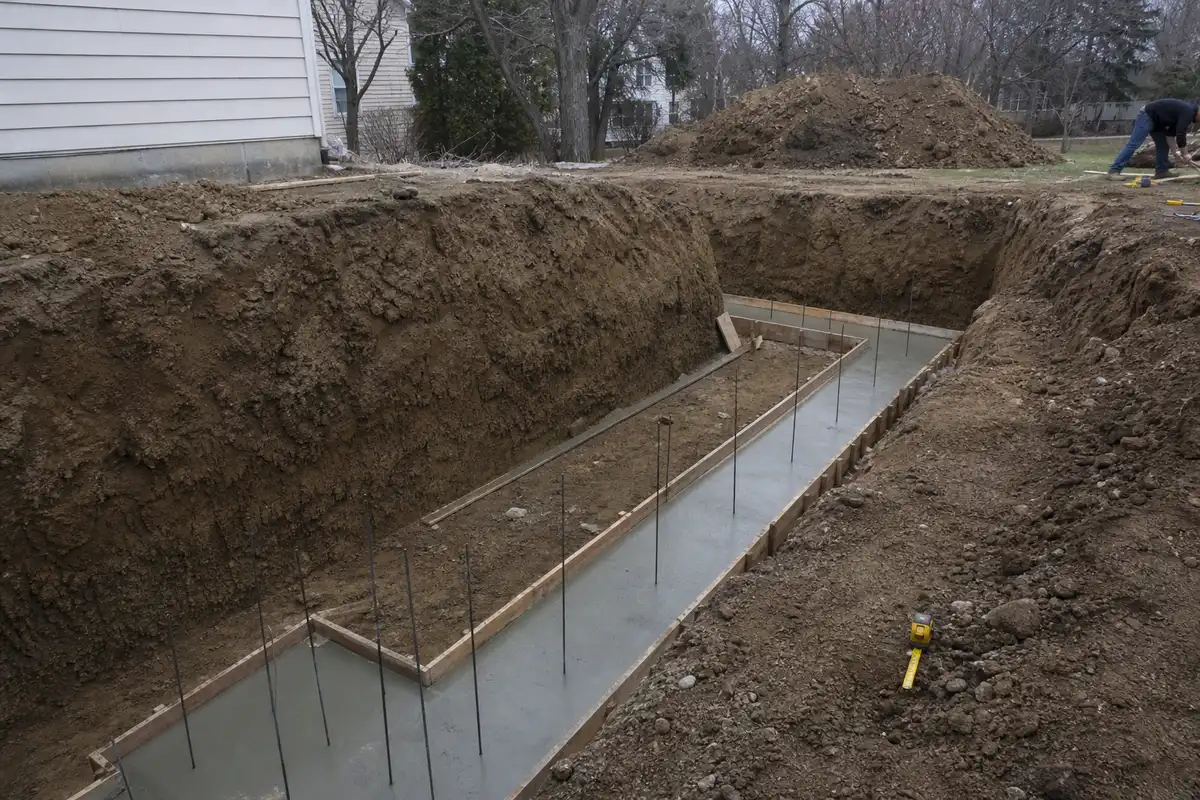
The 2024 International Residential Code says footings shall not bear on frozen soil unless the frozen condition is permanent (IRC Chapter 4). Rockford requires frost footings 42 inches below grade and inspects them before the pour (City of Rockford, building permits). Together those rules make a January footing pour hard: the soil at the bottom of the hole has to be unfrozen when concrete goes on it, and the inspector has to see forms and rebar first. If you need footings in winter, ask the crew how they keep the bottom of the hole thawed, and ask the city whether the inspection will allow it. For the footing rules themselves, see Rockford frost depth and footing rules.
Curing needs warmth, and drying needs time
The Portland Cement Association's durability checklist for concrete that will see deicers asks for at least seven days of moist curing at 50°F or above, followed by at least a 30 day drying period before the slab is exposed to freeze-thaw cycles and deicers when saturated (PCA EB001). A separate pavement research brief says about three to seven days of effective curing is needed for freeze-thaw resistance for typical slab mixes at room temperature (National Concrete Pavement Technology Center). Rockford's January normal low is 14.5°F, and a slab poured in November or December cannot meet that checklist outdoors without help. That is the reason many crews stop flatwork late in the season and start again in spring.
The first winter on a new slab
A fall pour is a different case from a winter pour. The slab goes in while the weather is still mild, then meets its first freeze while it is young. The Illinois Ready Mixed Concrete Association's residential guide and the Michigan Concrete Association's guide both say to keep salt and deicers off new concrete for at least the first winter and to use sand for traction instead (IRMCA, Michigan Concrete Association). Those are trade-association recommendations, not building code, and the PCA gives its own 7 day plus 30 day rule instead. Together they point the same way: protect the first winter. The full story is in rock salt, deicers and new concrete.
Questions to ask a crew before a cold pour
- What is the forecast low for the next several nights, and what is the plan to keep the slab above freezing while it cures?
- Is the ground frozen where the pour goes, and how is it being thawed?
- Is the mix air entrained, and what air content did the plant order? The 2024 IRC calls for 5 to 7 percent total air in exposed flatwork.
- Who calls the inspector for a footing, and has the 24 hour notice gone in?
- Would waiting until spring change the price? Ask for both numbers in writing.
Prices for footings, patios and drives are on the concrete cost page. They are national ranges, and a winter job can cost more for heat, blankets and extra visits, so ask for a written price that says what the crew does about cold.
When waiting is the better choice
A slab that freezes while it is young is the risk, and the damage may not show until spring. If the forecast is hovering near freezing, a delay of a few weeks may cost less than a surface that scales or a footing set on frozen ground. A contractor who says a pour is not worth the risk this week is giving you useful information. A contractor who says cold does not matter at all is not.
Walking and driving times on a young slab
The Illinois and Michigan trade associations both give the same opening guidance for residential flatwork: under normal conditions, foot traffic after 48 hours and vehicles after 7 days (IRMCA, Michigan Concrete Association). Cold slows the gain in strength, so a slab poured near the first freeze should not be treated as ready on the same schedule. Ask the finisher when your slab is ready, and read how long before you can walk or drive on new concrete for the longer version.
Spring pours and the last freeze
Spring has its own risk. With a normal last freeze of April 27 and a record of May 27, a pour in early April can meet a hard frost the first week. The soil is also thawed and saturated in spring. A crew that checks the forecast for the full week after the pour, not just the day, is doing the job properly.
Sources: National Weather Service, Rockford 1991-2020 normals; National Weather Service, first freeze dates; National Weather Service, last freeze dates; 2024 International Residential Code, Chapter 4 (foundations); City of Rockford, building permits; Portland Cement Association, Design and Control of Concrete Mixtures (EB001); National Concrete Pavement Technology Center, curing exterior slabs (2025); Illinois Ready Mixed Concrete Association, residential exterior flatwork guide; Michigan Concrete Association, driveway and sidewalk guidelines
Want a price for your own house?
Call, text, or send the form. You get a price back before any work is scheduled.
Quick answers
When is the first freeze in Rockford, IL?
The National Weather Service gives Rockford a normal first freeze of October 13. The earliest on record is September 13, 1975.
When is the last freeze in Rockford, IL?
The normal last spring freeze is April 27, and the latest on record is May 27, 1992. Plan spring pours with that range in mind.
Can you pour concrete when it is freezing outside?
The IRC says footings may not bear on frozen soil unless the frozen condition is permanent, and the PCA asks for moist curing at 50°F or above. A crew has to protect the pour, so ask how.
How many days a year is Rockford below freezing?
Rockford averages 135.8 days a year with a low of 32°F or colder, and a January normal low of 14.5°F, per the National Weather Service.
How long should concrete cure before it freezes?
The PCA checklist for deicer-exposed concrete asks for at least 7 days of moist curing at 50°F or above, then at least 30 days of drying. Ask your contractor how a late-season pour meets that.
Can I pour a patio in November in Rockford?
The normal first freeze is October 13, so November pours risk freezing while the slab is young. Ask the crew for a cold-weather plan in writing, or wait for spring.
Want a price on the job?
Send the job, the town and a rough size. A concrete contractor replies with a price before any work starts.
Prices and the full service list are on the homepage for a concrete contractor in Rockford.